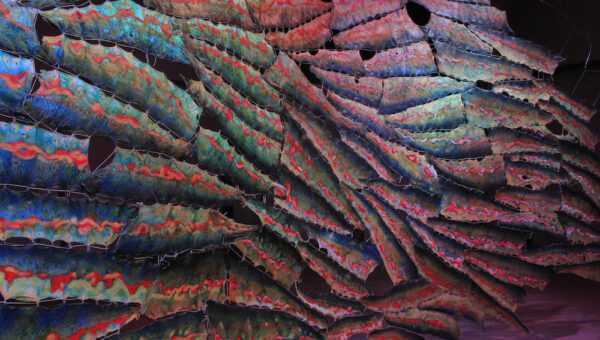

Lee Bontecou’s Nostromo


— so foul a sky clears not without a storm (Shakespeare)

Preparations: Take a walk in the common space of Olmsted’s horticultural park, central to Manhattan island geography. Linger for a moment at Willowdell Arch to appreciate the  stone voussoirs that line the arcade and support the rusticated underpass; and then allow a few additional moments to visit with Siberian husky Balto – the Alaskan sled dog who braved rough ice and Arctic blizzards to transport serum to the citizens of Nome, stricken by a diphtheria epidemic in terrestrial year 1925. He stands guard, memorialized in a bronze statue just beyond the arch. When your mindspeech has been silenced through remembrance and contemplation, and your senses refreshed by the fading autumn color and the nobility of these sights, follow an easterly course to 73rd street, and ring for admission at No. 25. Take the lift to the third floor, where the doors open onto the stillness of a retreat.


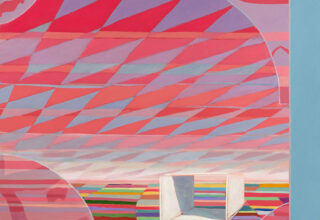
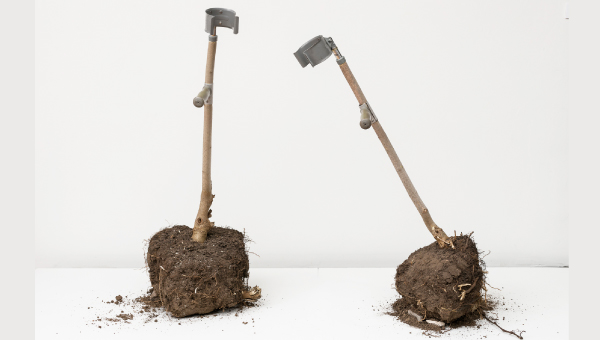
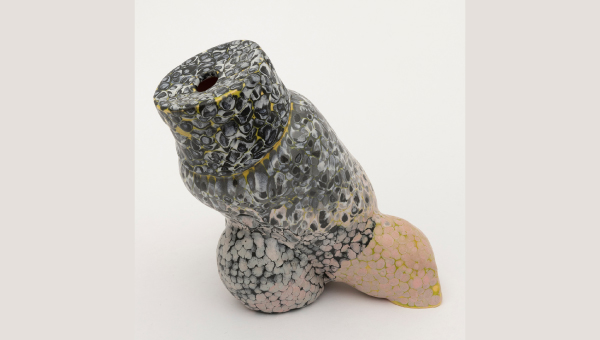
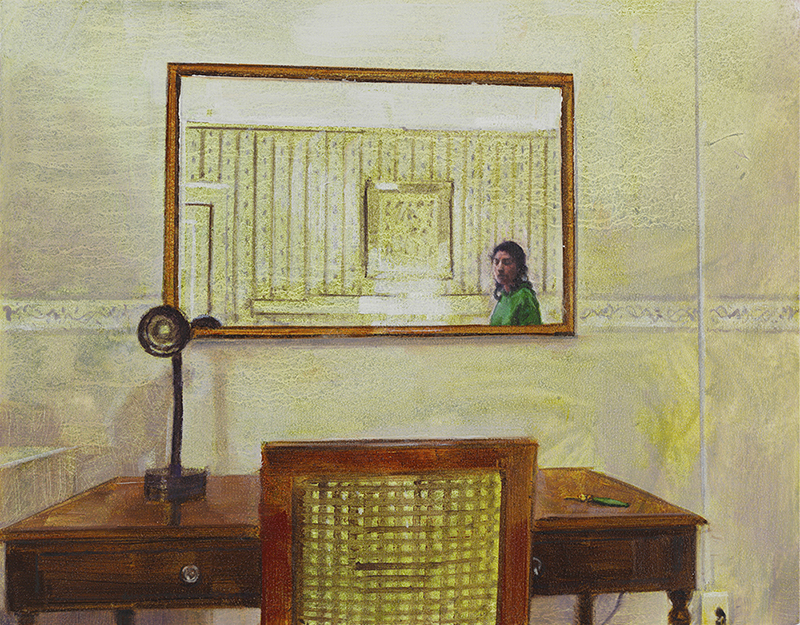
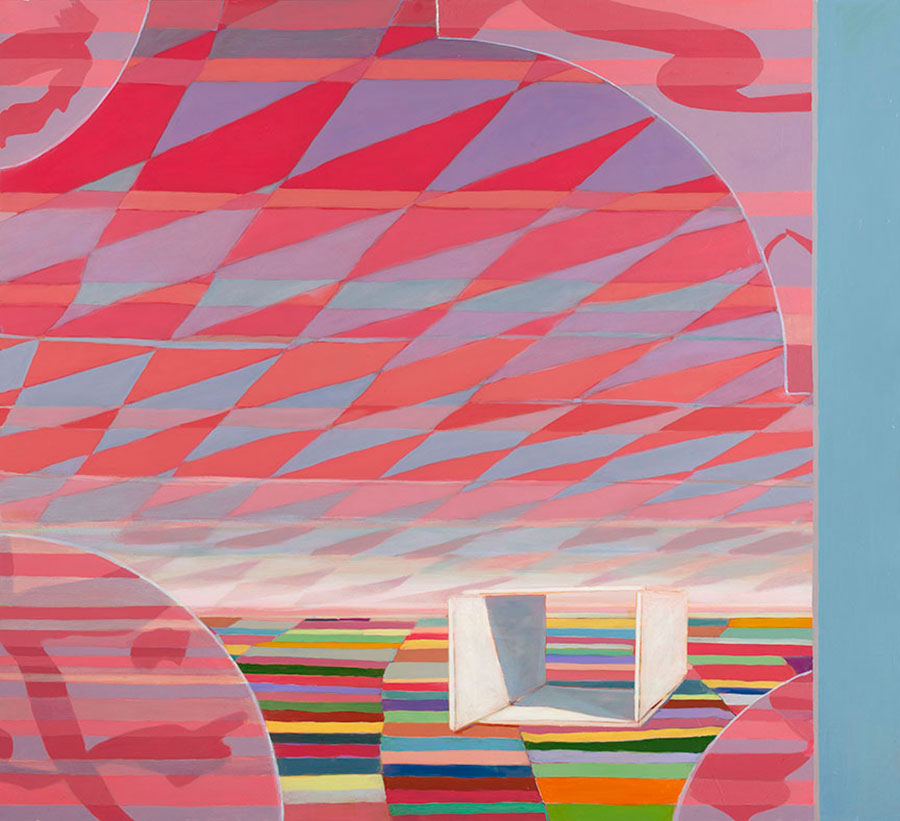
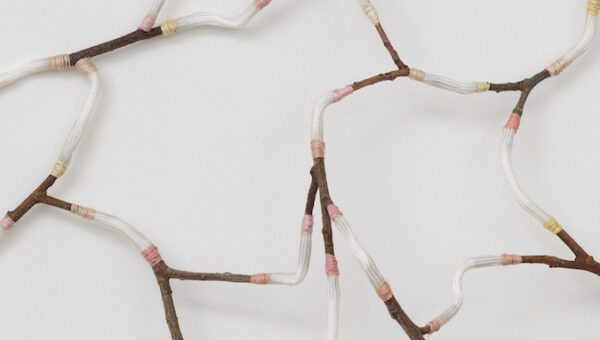
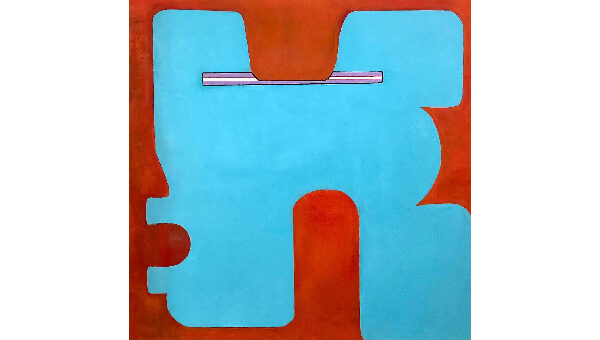
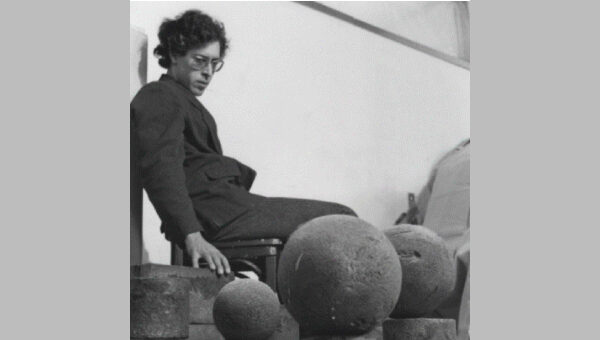
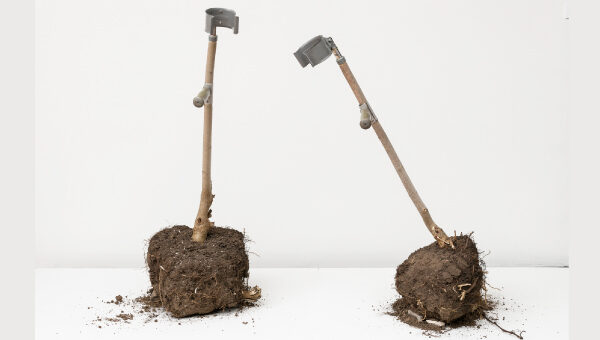
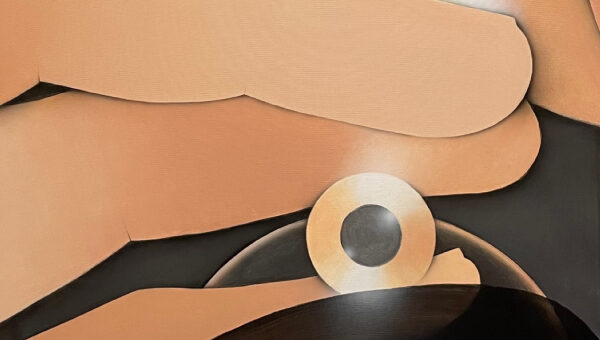
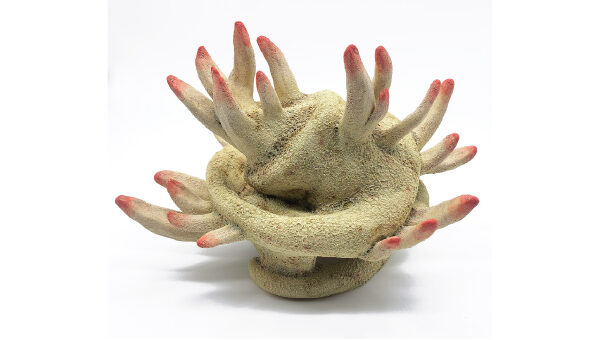
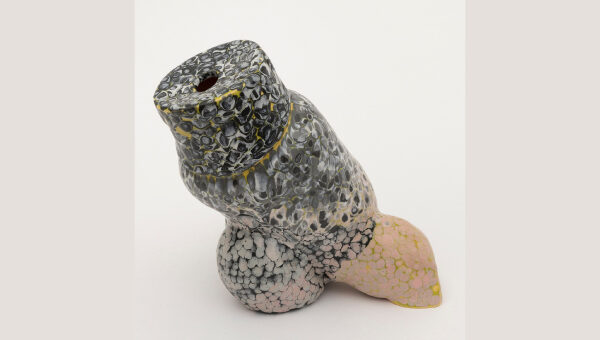
Engineered with a subtle force, Lee Bontecou’s fabrications are “a colossal embodiment of silence,” simul-taneously full of active life. Drawings, models, sand boxes, sand-pits, suspensions, biscuit sculpture, wooden jetties, bear witness to the organization of form ex nihilo; antiquity withdraws in sombre tatters – “the sun eating it up.” Coasting ports and portals; enormous semi-circular temples open to the sky and the ocean. Lofted gondolas float, invisibly anchored, like clippers that are powered by porcelain sails.

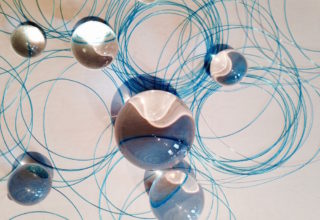
Broad curves define the skeletal matrix of blackened canvas and white porcelain that spur the sculptural suspensions. Wire tentacles advance into the plenum like chaff before a hurricane. They float still; where “never a strong wind had been known to blow,” but are haunted by the remembrance of currents that might have once glanced the surface of absent oceans, “like sinister pirate ships of the air, hove-to above the horizon.” (Has earth been depleted of water? Has it lost its aquarian nativity?)

Habitations or conveyances? Shadowed on one side, with patches of sooty fabric on an under side, skirting the horizon, and marking outermost points on the bends of forms that have no titles.

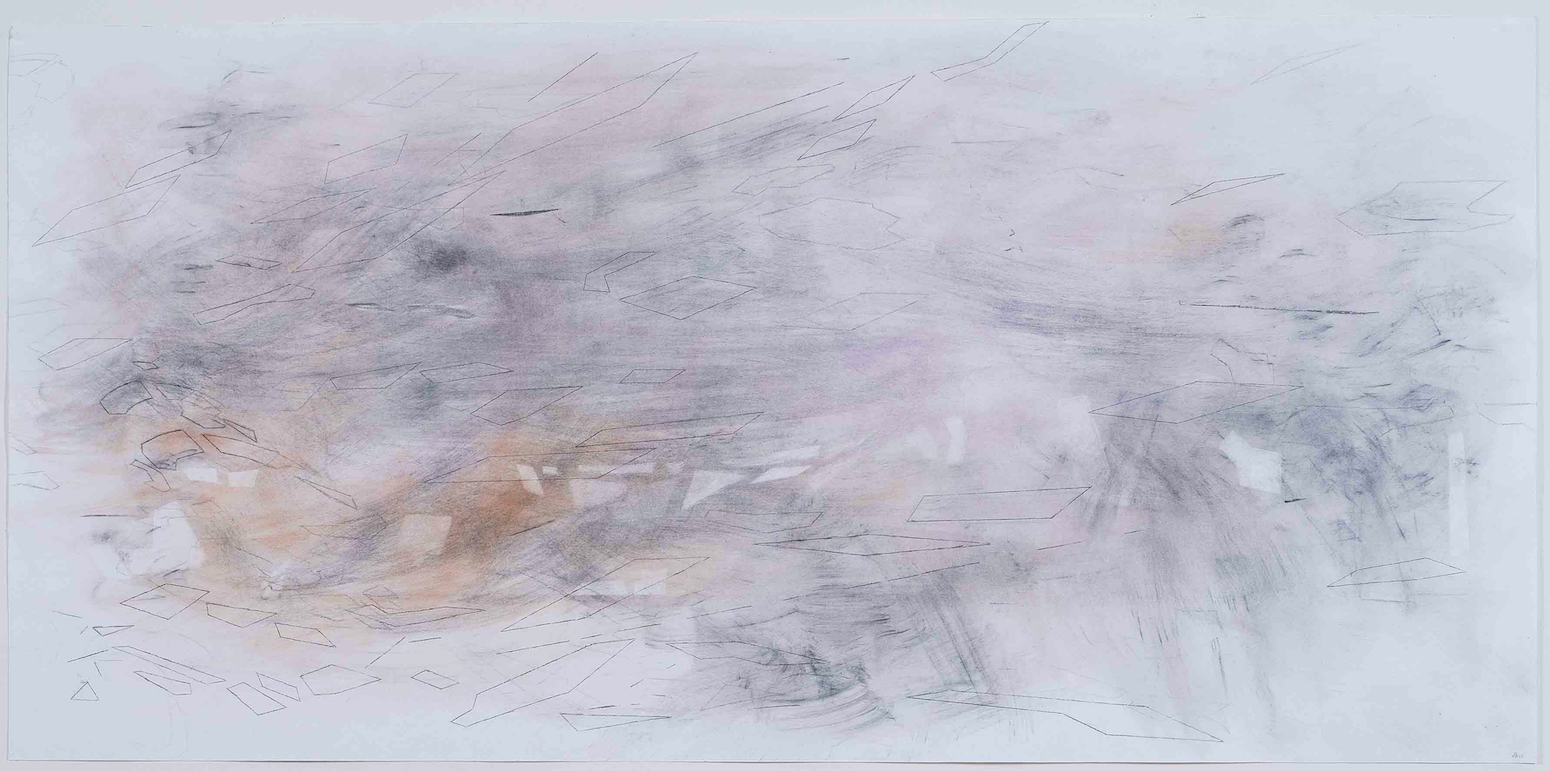
In drawings that are black and then white and then pottered with images the color of clay, vague forms weave lightly through the glare of a horizon or encircle the oculus of the mind’s eye, the bird’s eye, the reptilian eye, empty of all but a perfectly impenetrable black.

Bontecou’s worldscape is utterly waterless; the sand has not soil or nutrient enough to support a single blade of grass, “as if it were blighted by a curse.” I read Conrad’s Nostromo and am reminded of his observation that, “the poor, associating by an obscure instinct of consolation the ideas of evil and wealth, will tell you that the ground is deadly because of its forbidden treasures.”

Grey and black vapors trail out slowly and vanish into thin air along a waiting edge, which reaches for, but seldom wins, the middle ground. It cannot be held; it is eaten up and escapes one’s grasp in the offing.

“In its vastness your ship floats unseen under your feet, her sails flutter invisible above your head. The eye can not find out what work a man’s hand is doing in there; (or a woman’s) and you would be free to call the devil to your aid with impunity if even his malice were not defeated by such a blind darkness.”

Precipices cleave the hardened features of Bontecou’s constructions – glazed by heat; one form resembles an upright spiral of smoke (the remains of a camp-fire?), and is seen riding the sky like a schooner.  I gazed into these compilations until my eyesight dimmed, going dark in synchrony, my eye changing with the cinema of the forms. I was exhilarated by the force of character they revealed.

A multitude of small models are collected in the sand-pits; they are spectral and alive. They could have once been dwelling places, or their component parts; rich, and hungry, and thirsty –  with “tenacious ghosts suffering in their starved and parched flesh…”

Through the gaps between lines, forms, outcroppings, thoughts of a harbor tempt fantasy; as a refuge from the void. Instead, Bontecou releases us into a plain, curving away in shining parallel ribbons “on a belt of scorched and withered grass.”

Seive-like containers of granular fill, the sand-pits are no more than a half foot high, and about six paces across; an open view passes into opal mystery rough with spines, ceramic scrub, trees in petrified stands huddled close together; spiral clefts spring from shallow depressions; great distances are conjured, overhung by dry haze: the hulls of Bontecou’s extra-terrestrial vision “disregarding everything but the tyranny of time.”

Halo Jones, start December, end year 4952.

All quotes are from Joseph Conrad, Nostromo, The Silver of the Mine, and various subsequent chapters.

Images courtesy and copyright Lee Bontecou and FreedmanArt, New York

Posted in Reviews | Leave a comment

Foreign Correspondents

Click on the image to read the review.

Posted in Reviews | Leave a comment

Bellini’s Protestation

I recently found myself at The Frick Collection in New York (having temporarily escaped time and gravitational confines), where I was captivated by ‘St. Francis in the Desert’ – also called ‘St. Francis in Ecstasy.’ The artist Bellini raises endless questions for this visitor -I found some background on the protagonist of the picture:

Trained in chivalry (courage, honor, justice), St. Francis, and subsequently all Franciscans, take a vow of poverty. Their calling requires a self-regard of humility and restraint; they are the equal of others or of lesser stature.

I claim no training in the terrestrial cult of art history. I have read about its methods in the journals of artists that are preserved in our ontologies. Nonetheless, as a hypothesizer, I will attempt to cast a brief threadlight into its significance.

Generalizing, it seemed to me that features of the composition could be considered ‘Franciscan’ in style as it reflects restraint. Inwardness is a trait I have studied, and the saint appears to be addressing the immaterial in his surroundings, something utterly modest, even poor. He is unencumbered. With so few possessions, I surmise that privation is a requisite for the circumstance he seeks. In our age, his divestments would be considered very advanced. The picture is graced with an array of singularities – a book, a lectern with death’s head, a sole foliated tree, and a distant citadel that appears unoccupied.

Long centuries have catastrophically changed the earth since this picture was made. The green quilt of its natural cover has been ravaged by timbering, and the wind howls in channels through these hollows. Though over-populated now, the picture shows that empty stretches of desert, rock, and hillside once prevailed and supported simple life; a landscape in which contemplation and loneliness were still possible. (I have always wondered why loneliness was considered so problematic. Now we think of it as a state of being that is hopelessly lost to us. We study it in workshops on psychological archaeology. And we yearn for it, dream about it when we have a ration of sleep in which to dream.)

How is the picture timed? Hard to determine, because day to night is so fluidly reversible in my experience, and few have the luxury of slowing down to observe subtleties. Who can now truly understand the suspense of this pacing? In my world – none – except as an archaic stage of human development.

The picture suggests what used to be called sunrise (according to a cinema made to explain the picture’s meaning), but dawn – as a white suffusion in the sky – is a concept, metaphorical. It no longer exists phenomenally. When the saint’s chastened transformation begins he is positioned ethereally, gazing up and beyond the frame of the picture. The world around him trembles to reinforce his pose. He is ready to test the precipice.

When we join him, the seraph (not depicted, but a kind of fantastic flying creature typical in Christian imagery) has already marked his palms with the miraculous stigmata. Blink, and time, as a function of light, changes, appears burnished, older, humbled, and chooses to attach a shadow to St. Francis alone. He is allowed to age. The scene is full of detail but conveys the minimalism of what people on earth called solitude.

Illumination is crucial to its deep meaning, but difficult – if not impossible – to characterize or keep still; perhaps it is simply a reflection of Bellini -  a natural Sensitive, with a prodigious gift. It is at once an idea, but also a subject, an agency. It has no technological explanation. Considered as a radiance, it seems to emanate from St. Francis – in the softly painted folds of his ochre garment (though a cave of darkness follows him). His dress recalls the color of a place called Tuscany – and the Appenines (mountains I think) – as if the figure has been mined from the mineral grandeur of these ancient hills. In my studies, I came across some paragraphs by a writer named Albert Camus, who, after a second visit to a place called Italy in the year 1937, described this light as  “ . . . a dark flame . . . that Italian painters have raised from the Tuscan landscape as a lucid protestation…” (1) I am fascinated by this wondrous possibility.

St. Francis is the color of clay. His strand is the color of earthsea – green and blue. The rock surfaces are liquid – they wind in curves, leaving tide lines – a theology of water in what is now a burned world. Transubstantiation of matter is brilliantly captured, the conversion of substance, flesh and stone, and its consecration. Is this really the desert? Who can answer? Or, as the first title implies, a bygone state called ecstasy, possibly summoned by the glorious play of matter and light in a paradise lost, or the ecstasy of the communicant.

How this great and treasurable illusion of the past will effect me, I do not know. Except singularly contained on a square wooden easel, an island in a circular room isolated from everything else, and coming toward me at a perfect height – I wanted to enter, to step into this enviable seclusion. To be lonely and transformed.

Halo Jones, Year 4952


(1) Albert Camus, “The Desert,” (to Jean Grenier), 1937. I came across this faded yellow typescript (the kind terrestrial writers used in the twentieth century), in the files of a citizen who called herself a critic.


Posted in Random Thoughts | Leave a comment

The Apex Is Nothing

Alfred Jensen created works of art whose conception was subject to extra-aesthetic imperatives, even to the point of forcing “un-aesthetic” decisions.  This show exhibits essentially abstract works by a range of artists whose visual power is likewise catalyzed by the incursion or absorption of factors beyond the picture plane.

The center of energy in Jensen’s paintings and drawings sits on a boundary between abstract form and an array of idea structures. His intensely visual production isn’t representational in any conventional way, yet seems forcefully shaped by realities outside the strict visual concerns of painting or drawing (concerns like philosophy, numbering systems, mathematical and scientific ideas).

For other artists in this show such areas include statistical data, language and text, mapped social or political matrices, or a pointedly tactile reality that contests composed visual relations.  This artwork can embody an abstraction that seems formed, or even excitingly deformed and pushed into unexpected shapes, by collision with the “extra-aesthetic”.  In viewing such work, we feel the tension of our desire to pull what we see into an aesthetic framework, to recuperate what might seem like surprising choices and unusual structures back into a pictorial focus, to reconcile their obvious (if inscrutable) logic with the more familiar logic we expect to order the parts of a picture.

Ideas invested in art in this strange way can seem to present an invitation to solve a puzzle, to grasp superimposed patterns, or to finally resolve odd symmetries.  Yet, this process of thoughtful looking more likely leads not to an answer, but to a space.  Not to a something, but rather to a more valuable nothing.

Artists in the Exhibition:
Melissa Brown
Ingrid Calame
Linda Francis
Xylor Jane
Alfred Jensen
Paul Laffoley
Mark Lombardi
Dan Miller
John O’Connor
Roman Opalka
George Ortman
Bruce Pearson
Tim Smith
Jorinde Voigt
Ken Weathersby
George Widener

Posted in Curating Ideas | Leave a comment

BRIAN GAMAN

Brian Gaman once tried to make eyeglass lenses by casting the glass himself.  They cracked; he left them unpolished.  He kept the bridge and arms off the frame, leaving just two black-rimmed circles.   And oh yes, did I mention, he made them nearly two feet high each? They lean casually against the wall. You would never guess their true identity. Likewise another pair of spectacles also from the late 80’s, just as impaired, with a cataract of nylon mesh across the lenses. This time the frame is complete but disguises itself as a Jean Prouve-style bench or coffee table.  The steel legs fold under and in, the structure ready to be put away or taken out of a hypothetical carrying case. All these clues to its identity and still this shape is slow to announce itself as eyewear, nor does the title allude to such a thing; nevertheless, once you “see” the sculptures as pairs of glasses it is like the hag in the drawing of the beautiful woman—that old chestnut of a perceptual double-entendre.  Easy to miss but having seen it you can’t unsee it.  So too once you take in Gaman’s blinkers the ghosts of Harold Lloyd and Fitzgerald’s T. J Eckleburg, the optician whose sign hangs over the famously symbolic ash heap, never depart from Gaman’s work.  Comedy and dread, inextricable, an aversion to certainties and warranties, produce what Alexander Nemerov has called “an existential standoff.” These works, despite their shy claims, pun on Gaman’s long-term goal, to enlarge the field of vision.  Trouble is –like all the best artists—Gaman is bedeviled by a dybbuk of doubt. So everything attempted must be undone or effaced.  Sometimes you can even spend time watching the vanishing, as in the 1970’s video he made tracking the shrinking into a dot and subsequent disappearance over the horizon of a friend running away into the desert.

"Untitled, 1988, steel, glass, dimensions variable, each element 2" x 22" x 22"


"Untitled," 1989-90, glas, steel, galvanized steel, nylon, 20" x 18" x 124"

Dots and circles are everywhere in the work—floaters of shortsightedness or spots in front of eyes strained by looking into the sun. At Yale in grad school Gaman was interested in artists concerned with the gap between knowing and saying.  That means neither knowing nor saying. So the work is terse bordering on mute—hence the difficulty of discovering that occasionally those spheres are actually bubbles of hilarity, hiccups escaping from a Beckettian black humor hole. Indeed, inebriation is the genesis of pieces from the late 90’s. Having made a series of inverted tables, including one with a ROUND aluminum cup for the gum that would normally be stuck underneath, he developed a “parallel pictorial item for what would happen on those tables.”  He put beer bottles on photo sensitive paper, scanned in the image to files and enlarged it to 36 “x 44″, in other words, expanded the visual field to the threshold of incomprehensibility. Blind drunk. Not to mention that beer bottles leave rings on tables. He is literally making a point, or a series of points. If the point is warped by, say, its own peripheral vantage that’s part of the fun: when is a point not a point? Ultimately, however, looking at a silver print photo of a black circle, 50 inches by 94 inches, distorted so that the edges go in and out of focus, the humor has dried up to a speck and blown over into the land of minimalist gravitas.

"Untitled" (detail), 1996, painted wood, aluminum 6" x 30" x 110"

Untitled photograph (detail), untitled sculpture (detail), both 1989-90.

"Untitled," 1998, ink jet print, 30" x 24"

For a certain generation of sculptors conscription into the minimalist army required some deft draft dodging.  Gaman’s strategy, not surprisingly, turned out to be a sort of neither/nor impulse. Neither the ephemerality of Irwin’s optics—despite an ongoing concern with opticality—nor the clenched fist of Serra’s panzer brut, despite the heavy use of iron and often rusted steel. Instead he produces a “strong misreading,” an ironic collapse of antithetical terms, rendering the iconography of ethereal perception in iron.


Somehow this seems like what would happen if you persistently took the long view of things.  Maybe that’s why, from the long view, an icon of forward-looking modernist furniture design will seem antiquated, rusted.  And maybe that’s why in 1987 Gaman turned to making globes, literally “iron-bound,” as well as featureless.  You need a distant perspective to see the world whole.  These worlds, saturnine, and in fact ringed, are more often than not shown in pairs and are as flinty, stony-eyed and blank as the orbs of blind Tiresias.  Would it be fanciful to say they apply the seer’s doom to world affairs?  Perhaps.  After all the globes are emphatically simple shapes, suggestive rather than specific.  But what of that other most recent curve?  This time so small a segment of so large a circle as to appear almost flat.  Christopher Columbus! Four of these are presently underway, made of thin cast aluminum, a metal, but lighter.  It is as though to be farsighted and so able to see the world as a whole is to be philosophical, historical, but iron-bound and reductive; to be nearsighted, peering so closely at only the smallest of areas is to be IN IT, phenomenological, experiential but also astigmatic and distorted, like so many of Gaman’s printed black circles. Near and far, of the moment and of history—this dialectic continues to inform Gaman’s enterprise. And so presently he is scanning old drawings and printing out a few pixels to heights of seven or eight feet (the results, however, are far from pixilated). He is appropriating corporate logos and ads from the business section of newspapers featuring images of infinity in the form of endless water or sky, tilting them, of course, to skew the perspective. In a “purpose-driven, achievement-obsessed” world, Gamon’s economy is Spartan.  Deadpan. It’s a little like hearing this phrase come out of Lloyd’s straight, affectless face: “Jeepers, creepers wher’d ya get them peepers?”

Howard Foster

Untitled, 1987, iron, steel, all 34" x 20" x 20"


Posted in Reviews | Leave a comment

Louise Lawler, Fitting at Metro Pictures , and Practice

Thoughts on seeing Fitting At Metro Pictures — Louise Lawler’s show of pictures of installed and stored artworks — straight ones and others run through Photoshop so that they match the proportions of the walls they are affixed to height to height and width to width.  One — odd maybe — why not change the walls — change the building to fit the pictures?  And two — what is it about the unseen author — practitioner — of this art?

Adjunctive to both maybe questions of scale in the here-and-now.  Big billboards are everywhere.  Everyone’s got a huge TV and small screens so that it can be made certain that what’s on those big screens is never not seen.  All those displays carry the vibe and message of the in-place culture — crowding out what might mitigate against it. What does an artist coming from an adversarial place have left to do — not get bullied out of the argument?  Not just second — third — wave feminists jump up the scale of their work — whether it be big projected video and film or photos or whatever – notwithstanding the kiped gegaws of Olafur Elliason or Urs Fischer and the like – and is this looking like counter-talk or just part of the sheen — all just seamless now?

So juxtaposed to the straight pictures are the altered — stretched — squeezed — larger versions printed on vinyl — like advertising signs — adhered to the walls of Metro Pictures — one of the three hundred and fifty done-up galleries west of Penn South — the LIGWU houses out of the Mitchell-Lama program.  West Chelsea — current northern terminus of the High Line — whose boosters credit its change with bringing to 10th Avenue the world’s best chefs and apartment prices over two thousand dollars a foot in buildings by Jean Nouvel, Annabelle Selldorf and Neil Desari — all this helped along by the New York City adopted West Chelsea Zoning Proposal — is not the the Soho where Metro Pictures opened in 1980 and Louise Lawler’s work was seen early on.¹  Not the New York of the seventies and eighties where turf — vacant lots — given over to development now or occupation by the Guggenheim — mercifully absent the Gehry branding — and such — piers — the High Line — seemed up for grabs — de facto public places.  The “changing relationships between neoliberal urbanism and so called globalization…the neoliberal state becomes a consummate agent of…rather than a regulator of the market…the advanced capitalist world increasingly expresses the impulses of capitalist production rather than social reproduction…gentrification, which initially emerged as a sporadic, quaint and local anomaly in the housing markets of command-center cities is now thoroughly generalized as an urban strategy that takes over from liberal urban policy…densely connected into the circuits of global capital and capital circulation”. ²   One might not get to pushing the bricks around — reconfiguring — refitting — the streets but there might be an urge.  When one walks through Chelsea — and other New York neighborhoods — and certainly if one is old enough to have known something different — perhaps even if one isn’t — there is a feeling that something is never not part of the trip.

So the goods move around these places — and who gets into the treasure houses to render the dosh?  In this work is there some compelling absence making for critique or an ambivalence about how one becomes — perhaps despite best efforts not to  – an agent of the spectacle?.  And how have the critiques of the eighties traveled into the present and what does it mean when someone talks about an artist’s practice?  Some assumption that when someone says an artist has a practice is there thought to be a whiff of praxis in what someone says they do — that whiff  a product of assenters happy to go along for the ride and the critical and academic infrastructures  – all supporting the trade as normative — and ultimately the larger cultural hegemony as well?

1. “The High Line Isn’t Just a Sight to See; It’s Also an Economic Dynamo”, New York Times, June 6, 2011, sec. 1,      A18.

2. Neil Smith, “New Globalism, New Urbanism: Gentrification as Global Urban Strategy”, Antipode, 2002, 427-450.


Posted in Reviews | Leave a comment

LEE UFAN & HANS-PETER FELDMANN at the GUGGENHEIM MUSEUM by Nick Van Zanten


The two main shows up now at the Guggenheim, a Lee Ufan retrospective and Hans-Peter Feldmann’s Hugo Boss Prize show, are quite worth seeing.  Hans-Peter Feldmann’s work in particular seemed to give museum-goers pleasure, as I noticed many of them rubbing up against the walls of money and posing for pictures in front of it.  Both shows are contemplative and offer exciting, visceral takes on the sublime, giving visitors quite a lot to think about without losing aesthetic strength.  But what I’d like to talk about is the museum itself.

The Guggenheim (the building) is always fighting with the shows inside of it.  Despite presenting artwork in a considered and unique way, and being built around that presentation, the spectacle of the building’s form always jostles for attention with whatever is inside of it.  It’s torn between the competing demands of its creators that it be a “peaceful, elevating sanctuary” that imposes an order whilst also rejecting functionalism.  It is so far from the functional, quiet white cubes that we are used to, and so loud, that the views and experiences of it always distract from the work even as they intend to aggrandize it.  The non-objective work of Lee Ufan is just the sort of art for which the museum was intended, and the two fit together almost perfectly – yet it is still impossible to ignore the architecture.  So I couldn’t help noticing a few things about it.

The Guggenheim is, as we all know, a spiral ramp around an open center, with the art on the exterior walls.  These walls are divided into sections every 30˚, which more or less force curators to place works in their centers or at least create distinct tableaus within them.  Viewing the work, you travel between each separate alcove, up or down the ramp depending on your metabolism, stopping and considering each one independently, almost always as a single image.  Work is viewed by standing in the center of the alcove, taking in the whole of that section of the wall.  The effect is much like the frames in a slide show or a film.  The exterior of the building reflects the spiral of the interior, but with one difference: at the ground floor, the wall facing Fifth Avenue continues parallel to the street, then turns back, spinning into a second, much smaller spiral.  This is because the long ramp gallery, a continuous line travelled along by visitors, is actually a filmstrip running along the guide parallel to Fifth Avenue, between the two reels.  Each wall-separated module is a frame in the film, which is an image made by the visual art.  And while this may sound like a mere metaphor for the museum-going experience, the second spiral proves that it isn’t – the filmstrip is unspooling from one reel into another, which is how projectors work; the receiving reel is the smaller spiral.  The inside edge of the atrium even gets closer to the center the further it gets from the bottom (and so from the other reel that receives the film), replicating, like the rest of the building, a film projector.  Naturally, visitors enter between the wheels, where the film would be projected out – in an odd way, this is a reversal of how films are seen and projected.

The building is that it bulges out as it goes up, giving it its distinctive tornado shape.  Yet the open space on the inside is a regular cone, narrowing slightly as it goes up.  Each of these is more aesthetically satisfying than their alternative, but the combined result is that the “ramp,” which might better be described as the galleries or the limit on the distance available for viewing each piece, grows narrower as one descends.  Assuming that you start at the top, you find yourself pushed closer and closer to each piece as you travel.  This mimics, in a longer form, the regular way of looking at art on a wall – starting out far off, and ever so slowing closing in on it, the eye working as the hand did, from general to specific.  Wright has then forced us to follow a narrative of slowly and attentively approaching the work into the full museum experience.  This doesn’t necessarily affect the art viewing experience since it’s on a larger scale, but the architect, having provided a narrative medium by making the museum a filmstrip, has also provided a narrative of art appreciation.

Neil Levine noticed that Wright had written on one of the drawings for the building “Taruggitz” – ziggurat backwards.  This is, to some extent, what the building is, though I think its closer to a reversal of the minaret of Samarra than an upside ziggurat.  Should it be either the point of prominence, the sacred center, would be at the bottom of the museum.  It is worth noting that underneath the lobby of the rotunda – atop the ziggurat – Wright placed a movie theatre.  Ground level is the best place from which to take in the full beauty of the space. But this sacred point offers no view of the artwork.  Thus we can safely say that two systems are acting at once – the reverse ziggurat of the space, designed by a the architect to glorify himself and his work, and the filmic system of viewing the actual work.

Abstract painting, which the museum was designed to show, has an odd relationship to film because painting is composed of images that defy time and narrative and exist in absolute stillness.  Film, meanwhile, is composed of images, but these are defined by their positions relative to overall time and become, in the eye of the viewer, not a series but a continuous, changing image.  Before film and photography existed, paintings would tell a story by being hung and viewed in sequence, an idea that lead, by way of photography, to the invention of film.

Wright also placed eye- or lens-shaped motifs in the building (for instance in the fountain) and divided the whole rotunda, most obviously the dome, into twelve sections.  If looking up at the dome one sees a clock, then travelling through it, down to the bottom of the ramp and a sacred nadir at the tip of the reversed ziggurat, one also travels its perimeter, moving through time in relation to the fixed marks on the roof like the hands of a clock do.

It is hardly surprising that the museum is designed to place its art in a single possible narrative, since this is what any visitor necessarily experiences.  Yet it is remarkable how aware the building is of the implications of that – that by creating only one line of images that viewers can see in sequence, the building is turning those images into a film – while curators and artists struggle to take it into account and create the filmic exhibitions that the space is demanding.

The Lee Ufan show works well with the space, though.  The isolation that each alcove gives to its contents compliment that quiet, meditative manner in which Ufan’s pieces were made and in which they should be viewed.  The narrative of the show works well, though I did find myself reversing directions more than once.  But by placing each piece in its own film frame, and therefore in its own space and time, one can experience them much more profoundly than might be possible otherwise.  The final room of the exhibition is in the annex (as is the Feldmann), and the pieces suffer from not having the same sort of space which succeeds so brilliantly in the rotunda, where viewers are put in a proper frame of mind for each piece, and can face away from the atrium without feeling that they are missing a thing.


Posted in Reviews | Leave a comment

PAE WHITE – RESTLESS RAINBOW by Nick Van Zanten


Pae White’s Restless Rainbow has taken over a terrace on the third floor of the Art Institute of Chicago’s new Modern Wing, with an outpouring of bright colors printed on opaque vinyl along the glass walls.  Why this terrace is where it is, what’s so striking about it and why part of it hosts an expensive restaurant, is the view that it has of Lake Michigan and Millennium Park, and beyond it the dense center of Chicago.  It’s a fantastic spot from which to look at the sculptures in the adjacent park, such as Anish Kapoor’s Cloud Gate or Frank Gehry’s band shell.  White set out to break down the spatial dynamics of the terrace, closing it off to people inside of it and making it prominently visible to those looking up at it.  Before, this terrace allowed visitors to see everything while remaining hidden from street level; now it is conspicuously visible from the ground and offers no view.

Restless Rainbow is an image, a myriad of colored concentric circles that look like an enormous, psychedelic vinyl record. In the accompanying text, White says that she had the idea for the installation while wondering what would happen if a rainbow were to fall from the sky.  What if it became jumbled, and the misty colors of refracted light became the hard saturated colors of comic books, transparency became opacity?  I assume the artist wishes us to draw a conceptual rather than aesthetic connection.  Rainbow certainly changed a great deal in its descent; beside the obvious fact that the colors have no relationship to the spectrum of a rainbow, Restless Rainbow is by necessity static, concrete, and objective rather than fleeting, ethereal and personal to each viewer.  The chaos of bright colors bouncing off one another have a great optical effect, closing off the space through their sheer brilliance (viewers can still see over the top of the installation, but that view is dull by comparison).  From the inside the view is not only blocked but forgotten, sealed off by what’s on the walls, and the terrace becomes, in effect an interior room. All this play with the view made me think of how two-dimensional art traditionally works as a window.  White, an artist who has done many images of air, has taken this opportunity to do the reverse.  At the center of it all is an oculus through which one can still see out.  Humorously, this view is neither central to the original architecture of the space nor to its surroundings – looking out it one sees the flank of the Gehry band shell and some nondescript mid-century office towers. The expansive view offered by the terrace has been focused into a single point that might also be the weakest.

White’s description of where she got the idea from strikes me as an allegory for the creation of any physical image based off of a mental image that is, like a rainbow, apparent only to the viewer and only fleetingly.  This connection is driven home by the mysterious writing across a glass railing at the end of the terrace, facing out towards the street that cannot see it, which reads “i can never get it light.” If White really was trying to take an idea of a rainbow into the physical realm and make it into an art object she would have to take it out of the sky, to compromise and render it still and opaque.  She couldn’t get it right and make it light or fleeting; it would be heavy, dark, confused, and restless.

Pae White likes light and air, and a rainbow seems an obvious subject for somehow who’s already covered smoke and reflections.  Yet Restless Rainbow is neither light nor airy, despite the source material, which is what interests me so much about it.  Maybe she felt that the terrace already had enough of that, and the only way to go was the other way.  This is certainly what she did, backing away from her usual mode and drastically reworking the terrace in a way that we wouldn’t expect from her.   Compare this rainbow to one of White’s enormous smoke tapestries: both take an image that confuses the basics of objecthood and create an art object out of it.  But the smoke tapestries are images of smoke captured in a traditional way, and recognizable, and they were throughout the process, while Restless Rainbow is an image of a whole other sort.  The rainbow in Restless Rainbow shows difference more than presence, between the source and the art derived from it, and between it and White’s usual process.  Restless Rainbow is a commentary on the rest of her work, one that, like her other pieces, plays with what we think we can see.  Fittingly, it frustrates our ability to see.

White certainly asserts herself over the terrace. Restless Rainbow causes you to forget the skyline and boxes the space in, making it an interior by virtue of its presence, while at the same time leaving the area itself completely open. While some might feel compelled to bemoan the loss of such a view, especially if your wedding is taking place on the terrace, it’s hardly unique – there’s a bridge right next to the terrace that has a better vista anyway.  White’s new use of the terrace is as compelling as the view, and we shouldn’t feel that she failed to utilize it. Restless Rainbow blocks out almost all of it and manipulates the rest to its liking, turning the terrace inside out.  What more could we ask when giving such a space over to an artist?


Posted in Reviews | Leave a comment

RYAN TRECARTIN – ANY EVER by Nick Van Zanten

Video artist Ryan Trecartin, a veteran of Younger Than Jesus at the New Museum and the 2006 Whitney Biennial, inaugural winner of the monumental Jack Wolgin prize, RISD graduate, and 30-year old, is showing his very ambitious new piece Any Ever at PS1 this summer, marking his triumphant return to that museum for the first time since 2010.  This time he has half a floor of the museum to spread out over, resulting in a much different and my opinion far better experience of his work than he has been afforded here in the past.

Any Ever is a seven-channel non-linear quasi-narrative film with each channel screening on its own, in its own room with complimentary decoration, while also being part of one of two broader divisions of the whole piece, ReSearch Wait’S and Trill-ogy Comp.  This is my way of describing it, which is difficult to do.  Each channel is really a stand-alone film that cannot be put in sequence with any other, but which is at the same time a montage of parts of the larger whole.  It’s a film as a network or a cloud.

The films, directed, produced and acted in by Trecartin, Lizzie Fitch, his long time collaborator, and various friends and actors, are extraordinary and hard to describe.  The scripts fit somewhere between gibberish, feverish internal monologue, and the neologism-filled proclamations that are popular when talking about technology or business (or nearly anything else) these days.  Actors deliver the lines in artificially high-pitched voices.  The sense of non sequitur is aided by hyperactive editing, not to mention unexpected and bizarre turns in the already surreal plots.  Helpfully, important words often flash on screen, which gave me an odd sense of the producers being ever so slightly behind the times and out of style.  This aesthetic is aided by the sets, which like the props in the viewing galleries, are completely generic.  Characters are often oddly dressed and made up colorfully.  They seem to enjoy committing acts of violence, but bodily fluids are always represented with hilariously fake stand-ins.

Any Ever feels a bit like a film of a bad trip.  There are psychedelic colors, odd camera angles, sudden cuts, weird people doing impossible things, and it is filled with profound-sounding but actually meaningless gibberish, spoken by somewhat menacing people at a speed too fast for the viewer to catch onto.  It’s a projection of the worst of our world into an insane, terrifying hallucination.

This presentation of Trecartin’s work stood out to me not only for being so much larger (seven films!), but also for taking over the galleries and completely transforming the experience in doing so.  The soundtrack can only be heard on headphones, which creates an alienating barrier between the creepy ambience of the darkened rooms, which feel surreal but also utterly false, like a cheap stage set, and into which odd sounds and music are piped.  All the props are brand new from Ikea and Target, connecting them to the settings in the film.  This doesn’t arrest the estrangement, rather it makes the viewer feel that the place he is ill at ease in is the same bizarre world that he is seeing onscreen.

To help viewers make sense of it all, the first thing that one sees on entering is a schematic map, explaining the not only what’s where, but what the plots, characters, motifs, and general idea is.  I found this useful in understanding what is actually going on in the films, rather than just experiencing the overall aesthetic that they have.  But even with the notes I found it difficult to keep track because the form was so much more powerful than the content.  It feels as if the aggressively jittery, hallucinatory form was designed to block out the confusing, ambiguously present content (the wall map has a comment to the effect that some viewers may never notice any sort of content, while others might – both must to be valid experiences of the piece).

I can’t say that I find the content particularly compelling.  Trecartin seems to be satirizing American consumer culture (ReSearch Wait’S) and its corporate managers (Trill-ogy Comp).  The form seems to be poking fun at it as well, but I can’t help thinking that the parts don’t compliment each other.  Trecartin reacts to the absurdity of postcapitalism all by shouting back the gibberish that he hears, making a vague but not convincingly serious attempt to make sense of it.

One claim made by the wall map is that the two parts of the diptych are tied together into a “yin and yang” of “nihilism and boundless meaning.”  Well, okay, but “boundless meaning” – meaning without any constraint and so without any definition – is meaningless.  Boundless meaning is as equally devoid of real meaningfulness as no meaning (“nihilism”) is.  In fact, the two are just different varieties of meaninglessness; a yin and yin defined only by their opposition to a forgotten yang.  Any Ever is a diptych positing the opposition of being nothing at all and being everything at once, with the possibility of simply being something being out of the question.  The same text mentions the idea of a sort of physical “synesthesia,” where reality becomes perception to the degree that one is whatever one thinks, says, or does.  This phenomenon is familiar – this is what happens in movies and plays.  Actors become characters and these characters are whatever the actors do, regardless of their reality.  Actors often defy the laws of physics in films.  Trecartin is saying that postcapitalism has reached a height of spectacle where everything is a performance and there is no real constraint of original identity to the actors – where there is no something, only everything they want to be.  Only meaning, free of constraints.

On paper I completely understand what he is trying to say, and I generally agree with it.  It’s great that he’s out there saying it.  But in the gallery I can’t figure out if he is actually saying it.  Watching the films, I find a mocking pastiche of our culture, a shrill parody that amplifies the negative until it has become something abominable and then promptly decries it.  Not a satire, but an obnoxious, mocking tirade against a straw man.  The form works as a satire, as do the ideas that define the content of the films, but somehow those ideas seem to slip away in the actual execution, to say nothing of the montaged plot.   What is left is a just a group of insane people acting crazy in an unsound world.  I guess that this is Trecartin’s point, but it’s remarkable that something so amazingly un-subtle could result from all this that went into it.  Any Ever sits, intentionally, somewhere between meaning nothing and meaning everything, and so it doesn’t really mean anything.  I guess that’s a fittingly inauspicious reflection of our world today, but this absence of meaning left me unsatisfied with it as art – something that may have been meant to happen.


Posted in Reviews | Leave a comment

Vision is Elastic. Thought is Elastic

The most beautiful photograph I ever saw? I have described it here before. An exhibition of Sam Wagstaff’s photography collection at the Wadsworth Atheneum in Hartford Connecticut: the usual canonized suspects are all there.  Then, unannounced, at a distance across the room, scratching at the corner of ones eye, a small –4×6 maybe– black and white print.  As one gets closer the crumples and creases show seemingly more than the image: cracked emulsion chipping off, a missing corner I think. It was a little too big to fit a wallet. More likely a photograph one would safeguard between the pages of a book, ones diary perhaps. It was a posed image. It revealed a man and a woman facing the camera: Bonnie and Clyde.  Unlike the Bourke-Whites, and the Mapplethorpes of Wagstaff’s collection this one was anonymous. An authorless photograph, it constituted a gesture between the two pictured people.  From him to her, and her to him: the camera as close to a love letter as it is ever going to get.

There is a commonplace that has been foisted upon us of recent decades that meaning is retrieved from the visual through words. That the one, the visual, is written over and through with the other, language –be it the language of thought, text or speech– is broadly speaking the conceit. A conceit, it often feels, pushed to the limit where language is framed as the redemptive coda to the mute, all but autistic, image.  Layers of pre uttered and pre digested syntax, grammar and vocabulary hang in the room. Ghosts! There is no clarity of voice just a relentless heteroglossial squabble.  Thus the names Faye Dunaway, Warren Beatty and Arthur Penn will forever haunt Bonnie and Clyde’s photographic love letter.

“Vision is Elastic. Thought is Elastic,” the current show at Murray Guy gallery wants to take a look anew at the collision between photograph and word or, more precisely in the gallery’s naming of it, camera and notebook. The show’s title comes from a journal entry of David Wojnarowicz.  And anchors us as such within an art practice shaped by a dialogue between fragments of memory and wishes that many did not want uttered.  The show “explores relationships between photography and activities of reading, writing, and note-taking”. One might commit to ones diary ‘I love him’ or take his photograph.  It might be the same thing.

James Welling’s Diary of Elisabeth C. Dixon, 1840-41 and Connecticut Landscapes, is a series of images of the artist’s great-great grandparent’s diaries. Executed over an eleven year period, the work consists of small, (that is to say, the size of photograph one might slip between the pages of the aforementioned diary), black and white images of elaborate, cursive italic writing across diary pages. Leaves, blossoms or ferns are pressed between pages of said diary, while melancholy landscapes anchor the whole trying to stabilize a sense of place and time.  Welling has worked over and through photography’s history throughout his career. The pressed flowers rhyme with his extensive repertoire of floral photograms, themselves echoing primitive photography’s cameraless image making.  History and memory turn each other inside out and the diary and the camera emerge as devices for remembering even as illegibility clobbers the remembered. That the handwriting of Welling’s Grandparent is, if not illegible, then rather hard to read ties the hands of Welling, his grandparents and the current viewer behind their backs. What remembering is this that we grapple with? The Grandparental trip that the diary documents; photography’s pre-history or the difficulty of talking about how we remember, or, worse, remembering how we remember.  Yes there is a looping reflexive collapse precipitated here.  But Welling has for many seasons made hay with this posture of banality that conceals smarts and erudition.

In the grandparent’s diary writing –well, meaning actually– collapses into the act of making writing beautiful.  While photography, in Welling’s oeuvre, as mnemonic act collapses into the limitations of barely getting out of the darkroom. Welling is demonstrating or perhaps showing rather than telling, that language is not going to explain anything.  Language is not going to clarify images. Language becomes a smear upon the camera lens.  There is, I have always felt, a depressive tone to Welling’s project. There is a wanting of clarity evoked, but a depressive recoil over the realization of its impossibility. Love letters would win no hearts if Welling were in charge and Bonnie would forget Clyde if Welling were the chaperone. All of which is why the Welling series might be the piece that best highlights the shows claims to symbiosis between photography and other notational practices. It is the symbiosis of the scar and the flesh when you are not sure which is which.

This opaque and deeply evocative lilt of language photographed recurs in Babette Mangolte’s image, Annette Michelson,  Bookshelves on the Upper West Side in 1976. (1976). Many, many, words lined up in many, many books belonging to a founding editor of the journal October trigger a Benjaminian reverie around libraries and book collecting. Benjamin’s short essay speaks of the joys of collecting books. Of buying, borrowing and (pretty much) stealing them in the act of borrowing. Michelson’s book-spines, turned toward the viewer, tell us a few explicit stories; Kurt Schwitters, Beethoven, Jasper Johns are visible and legible. But mostly the books and journals are mute: just books and books and books and journals and…. The top shelf is loaded with what seems to be several hundred copies of a scholarly journal: it has the size, heft and un-glamour of a just such a 1970’s document. Something like the unvarnished matt bindings of New German Critique. Down toward the bottom many months worth of magazines turn narrow spines toward the camera while third shelf down, middle of shelf; those could be a collection of Paris Reviews. And then we run out of shelves! Badly so, with perilous, ready to topple, piles on chair and end tables. And then we have, or in fact do not have, the absent reader. Michelson’s empty rocking chair, at rest, blankly sits before us. Yet we do have her presence. Her depth of intellect and voracious cultural interest is the imposing personality marking the scene. Not depressive here, instead the clutter of read or unread books describe or diagram the owner’s intellectual idiom: the personal, intellectual contour of the friend of the smart Jewish girl with a typewriter, with whom –in 1976 as luck might have it– Michelson inaugurated a journal, a collection of words and pictures after all, that transformed New York cultural and intellectual life for ever.

Roni Horn’s Still water (The River Thames, for Example), 1999, presents as the work here with the most conventional relation of caption to image: i.e. caption will ground image, image will enhance caption.  Except that in Horn’s work the image deliberately does not offer the goods to back up the caption. Opacity, murky depths, the still waters of the title, the swirling, Rorschach surface of water occludes that possibility. The captions are rich with information of historical events often baited with significant drama. While the images present an opaque sameness of moving water. Framed individually, torn from the flow of the river, different images allow different textures to emerge; an eddy here, a whirl there, or frothy pollution in this image. Colors shift, apparent depth changes. Superimposed by the artist upon this virtual abstraction is a history of events and psychological charges the river has borne.  These events are of course only knowable through the narration by Horn. Nothing in the images evidences said happenings. She tells us of the suicides, say, that occurred here in this place.  There is thus a whisper of the notion of charged place.  Title your photograph ‘the chair where Salvador Allende died (see semiotext, Autonomia, 1980, p132) and sleight of hand/word imbues the scene with a whole other relational context. Importantly in the exemplary Allende photograph there is a bloody stain that draws one to puzzlement before the caption closes down the freely associative, promiscuous wandering. For Horn there is little formal excitement or referential enigma in the images and thus little incentive for aforementioned wanderings. It is this, which defines the moment where she makes her play. It is banality, a lack of melodrama’s visual evidence (or real political drama’s evidence) that turns the tables. It is a device kin to Welling’s photographs of barely legible words in that both coax language to tell little (or better, to falter in the telling). But Horn’s tactic hinges upon a site where language is tasked with this very responsibility: to tell, to explain.  That captions ground images, and that images illuminate their captions has been the rule since monks scribed in cells.  Contemporarily it is probably W.G. Sebald who has pushed the contrarian hand most fully toward overturning this maxim. For Sebald images sans captions drifted around the text fostering an inkling or two of connection to the pair of pages sunder current scrutiny. But it was in minding the gap between image and text that he fostered a certain autistic relation between the two. Horn’s captions brim with unhinged vigor, vis their images; indeed they seem hysterically expressive against the catatonic photographs. You could drown in one and swim in the other.

David Wojnarowicz, invoked as the catalytic Magus of this show, used much language in his notebooks and artwork too. He had a lot to say about a lot of things, about, for instance, social and sexual glues other than language; about the politicization of sexuality and about the terrorization of particular groups by the United States government. Wojnarowicz for sure saw, through the chimera of his Rimbaud romance, the misery of America circa 1980’s. In a passage from his memoir, Close to the Knives, Wojnarowicz laments, “I want to throw up because we’re supposed to quietly and politely make house in this killing machine called America and pay taxes to support our own slow murder and I’m amazed we’re not running amok in the streets, and that we can still be capable of gestures of loving after lifetimes of all this.” Indeed! Wojnarowicz’s practice was infused with the personal and the sentimental –as well as the political. And also with a knowledge of misery and want. His practice careened back and forth between the written and the visual sometimes seeming as if there were really no difference between the two. Which one might hope, in world where many artists feel no need to be defined by the consistent use of given medium, would be a norm.  In, When I put my hands on your body, 1990, the piece shown here at Murray Guy, Wojnarowicz silk-screened onto a 36 x 47 inch photograph a text from his own prolific writing. Unlike Roni Horn, caption here scars the photograph and the latter loses clarity through its bruising by words:  “If I could attach our blood vessels so we could become each other I would. If I could attach our blood vessels in order to anchor you to the earth to this present time I would. If I could open up your body and slip inside your skin and look out your eyes and forever have my lips fused with yours I would.”  A –probably, but I guess not necessarily– sexual, body-fusing mutes the question of language’s utility. Elsewhere it has been said that, we have language because we have bodies and bodies cannot be joined together, that “there are languages and language because there is want and want is misery”. Wojnarowicz’s work, choreographed as psychologically primitive, sexually total, and politically canny poses the possibility –or wish, or dream wish– for a relationship of merger where there is no need for language. Merger –if only (sigh)–trumps misery and want.

Freud is hiding somewhere around here. Joy Episalla will show us just where.  And yes, he is of course hiding somewhere between the lines. 5 Women. Freud’s bookcase, London, 2011, is a medium format image of the Great Man’s bookshelves. Rows of books again, mostly, as can be gleaned from this image, on antiquarian matters and a glimpse or two of his antiquities around the edges of the tomes. It is a snap taken in Freud’s London redoubt. Post flight from Nazi book burners he was installed there as a kind of museum of himself. Appended to his shelves are photographs of five women important to his life and to the development of psychoanalysis: muses, mentees or both So who dare analyze the analyst? Or if not him then what it means that he places in close proximity to his beloved library and antiquities images of these 5 women? Episalla will, visually mind you, take a stab at it. Again it is charged space. The juxtaposition would mean little if were not the library of the guy who invented the Twentieth Century or at least a good part of it.  But that disputable conceit that I spoke of earlier, “that meaning is retrieved from the visual through words” has come, in some quarters, to define his practice.  It was in his dream book that he largely painted himself into this corner. That dreams, essentially visual phenomena, can only be returned to some semblance of sense through verbal interpretation was the picked mantra. But of course dreams also taught him and us about visual tricks, tricks of placement, juxtaposition.  They taught us about a sense of uncanny presence.  And it is the thrust of this show that there is something about proximity, about the placement and closeness that is crucial to describing and understanding the relationship between image and word. Like photographs placed on your bookshelf.

I would like to think Freud was also begging us to recognize a desirable muteness; an extra-linguistic form of relational encounter. The kind of thing that might crop up in say the pleasure of just having that image, in lieu of the actual person, of the loved other close at hand. It is important that it is one of the possible and frequent –though little mentioned in cultural studies use of psychoanalytical theory– effects of the analyst’s famous silence in the room that the two people there experience a quiet closeness, a relatedness.  What I am referring to is not necessarily an analyzed part of the psychoanalysis. But then so much of said relationship is exactly that: not analyzed, just experienced. All this is well beyond the ken of meaning –meaning being a lackey of language– but Bonnie and Clyde new something about this, or, so I would again like to think. They new where to keep the memento mori photograph for safekeeping: no bullet holes!


Vision is Elastic. Thought is Elastic

Murray Guy Gallery

453 w. 17th street


Posted in Reviews | Leave a comment